Never to Return by Robert Nersasian & Randall Peffer
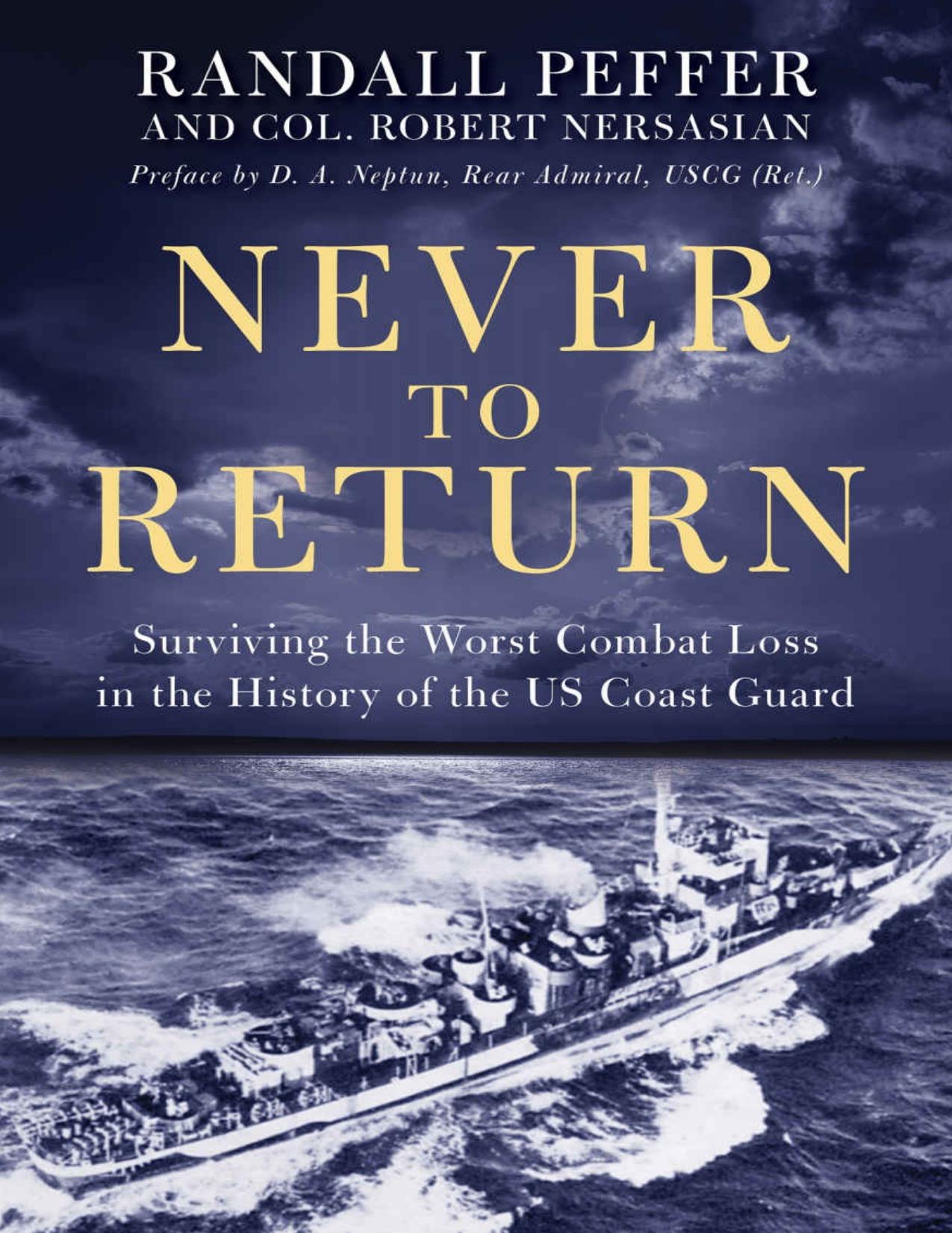
Author:Robert Nersasian & Randall Peffer [Nersasian, Robert]
Language: eng
Format: azw3, pdf
Publisher: Lyons Press
Published: 2017-10-01T04:00:00+00:00
Chapter Twenty-Three
Hold Your Breath
March 9, 1944, 2030 Hours
Ping. The sound echoes through U-255. You don’t have to be the Funker wearing earphones to hear it. Ping. Unconsciously, men hold their breath. Ping. Dieter Hengen, the first watch officer, has probably started swearing in his head, started composing the narrative that he will one day write about tonight for Horst Bredow, the long-term curator of the Deutsches U-boot Museum in Cuxhaven. Ping. He’s young and anxious with dreams of love and life after this war. Ping. A less battle weary skipper than Erich Harms might think, Here we go. Ping. He might feel the thrill of the fox and hounds game beginning in earnest, might feel that his chance is coming to prove to himself, his crew, and Grand Admiral Dönitz that he can outsmart the American hounds. Ping. Every seven seconds, ping.
But this pinging is something that Harms has heard all too many times from English and Americans hunting his U-boat. The source of that ping is the echo location device that the English call “asdic,” a term with its origins in the Anti-Submarine Division of the Royal Navy, and the Americans call “sonar,” an acronym for SOund Navigation And Ranging. These pings are the sound of the second Feger that he knew would be coming for him. Ping is not just the probing of his enemy’s sonar. Ping is the sound of fear.
Who knows what kind of death and destruction Harms’s T5 has wrought on the first destroyer? Perhaps just a wound, but possibly total devastation. Unless he surfaces to see, a submariner will never truly know the effects of a torpedo launched blindly during a crash dive. One thing is certain. The T5 hit its mark and one American destroyer escort is in pain. The Funker can still hear it on 255’s hydrophones. The wounded American’s sister is surely hungry for German blood now, Harms’s blood. He’s at 160 meters, nearing 255’s maximum service depth. But maybe he should push the boat deeper because these pings sound clear as a bell, the heavy whir of the enemy’s props rumble through 255 like there’s no shield of thermocline overhead to deflect sounds. If he doesn’t do something fast, the second destroyer will find him. Then the chances are just about nil that he will ever breathe fresh air or see home again.
Over his five years in the Kriegsmarine, Harms has committed the U-boat Commanders Handbook, known as the “U.Kdt.Hdb,” to memory. He has lived by its fundamental premise:
The theoretical knowledge of the weapon, and of the appropriate tactics, must be supplemented, in the last resort, by the decisive requirement of a war-like spirit and an audacious outlook. The essence of submarine warfare is the offensive! For the commander of a submarine, therefore, the maxim: “He who wants to be victorious on the sea must always attack!” has special meaning.
How many times has he heard his leaders promote a ruthless and indefatigable spirit with phrases like “The weaknesses of
Download
Never to Return by Robert Nersasian & Randall Peffer.pdf
This site does not store any files on its server. We only index and link to content provided by other sites. Please contact the content providers to delete copyright contents if any and email us, we'll remove relevant links or contents immediately.
| Africa | Americas |
| Arctic & Antarctica | Asia |
| Australia & Oceania | Europe |
| Middle East | Russia |
| United States | World |
| Ancient Civilizations | Military |
| Historical Study & Educational Resources |
The Radium Girls by Kate Moore(12097)
100 Deadly Skills by Clint Emerson(4975)
Rise and Kill First by Ronen Bergman(4842)
The Templars by Dan Jones(4741)
The Doomsday Machine by Daniel Ellsberg(4559)
The Rape of Nanking by Iris Chang(4267)
Killing England by Bill O'Reilly(4046)
Stalin by Stephen Kotkin(4010)
Hitler in Los Angeles by Steven J. Ross(3983)
12 Strong by Doug Stanton(3584)
Hitler's Monsters by Eric Kurlander(3389)
The Code Book by Simon Singh(3256)
Blood and Sand by Alex Von Tunzelmann(3244)
Darkest Hour by Anthony McCarten(3165)
The Art of War Visualized by Jessica Hagy(3048)
Hitler's Flying Saucers: A Guide to German Flying Discs of the Second World War by Stevens Henry(2779)
Babylon's Ark by Lawrence Anthony(2723)
Tobruk by Peter Fitzsimons(2566)
The Second World Wars by Victor Davis Hanson(2555)
